El Niño winters have a reputation: storm track shifts south, the Pacific Northwest dries out, and the Southwest gets an unusually good ski season. We tested that with a station-by-station comparison of El Niño-year snowfall against each resort's all-year average, using 107 SNOTEL stations matched to 147 ski areas across the western US, drawing on 77 water years of record back to 1950 — 27 of them El Niño, 27 La Niña, 23 neutral. The winner, by a landslide, is Ski Apache, New Mexico, which sees more than double its normal snow depth in an El Niño year. Case closed, right? Not so fast — there's more to the data, and it's not nearly as flattering to the south as that one number makes it look.
The Winner: Ski Apache, by a Mile
Ski Apache in New Mexico tops the entire dataset with an El Niño Ratio of 2.184 — its snow depth in El Niño years runs more than double its all-year average, jumping from 10.8 inches to 22.7 inches at the nearby Sierra Blanca station. Four of the next five biggest gainers are also New Mexico and Arizona desert ranges: Sunrise Park (1.59), Pajarito Mountain (1.50), Angel Fire (1.46), and Sandia Peak (1.42).
| Resort | State | Avg Depth | El Niño Depth | El Niño Ratio | N Yrs |
|---|---|---|---|---|---|
| Ski Apache | NM | 10.8" | 22.7" | 2.184 | 9 |
| Sunrise Park Resort | AZ | 9.6" | 15.8" | 1.592 | 34 |
| Pajarito Mountain | NM | 11.8" | 18.9" | 1.500 | 27 |
| Angel Fire Resort | NM | 14.0" | 20.9" | 1.458 | 15 |
| Sandia Peak Ski Area | NM | 17.4" | 26.2" | 1.422 | 35 |
| Ski Santa Fe | NM | 25.1" | 37.2" | 1.352 | 32 |
| Arizona Snowbowl | AZ | 19.1" | 23.0" | 1.297 | 31 |
| Lee Canyon | NV | 16.3" | 20.8" | 1.271 | 18 |
So the south really does benefit, and the effect is real and large in percentage terms. But look at the second column. Ski Apache's all-year average is 10.8 inches of snow depth — that's a thin base to begin with. Doubling almost nothing in percentage terms is still not very much snow in absolute terms. These are desert and high-plateau ranges (Sacramento Mountains, Sandia, Sangre de Cristo) where a ski season exists at all only because of elevation, and El Niño moisture is the difference between a marginal year and a passable one — not between a passable year and a deep one.
Filtering for a Real Snow Base: 50+ Inches
To find out where El Niño actually delivers meaningful snow — not just a big percentage on a small number — we re-ran the comparison limited to resorts with an all-year average snow depth of at least 50 inches. That cuts the desert Southwest out almost entirely and leaves the Rockies, Sierra, Wasatch, Cascades, and a handful of Alaska resorts. The leaderboard changes completely.
| Resort | State | Avg Depth | El Niño Depth | El Niño Ratio |
|---|---|---|---|---|
| Wolf Creek Ski Area | CO | 79.0" | 86.1" | 1.060 |
| Alyeska Resort | AK | 80.5" | 73.9" | 1.051 |
| Hilltop Ski Area | AK | 58.4" | 49.5" | 1.042 |
| Powderhorn Mountain Resort | CO | 53.2" | 54.6" | 1.041 |
| Winter Park Resort | CO | 56.5" | 59.0" | 1.040 |
| Telluride Ski Resort | CO | 56.8" | 58.4" | 1.038 |
| Mary Jane | CO | 60.5" | 62.5" | 1.032 |
| Silverton Mountain | CO | 56.6" | 58.1" | 1.021 |
Once you require an actual snow base, the best El Niño performer in the West is Wolf Creek, Colorado — and its edge is a 6% bump, not a doubling. Most of the rest of the top group clusters between 2% and 4% above normal. That's the real magnitude of the "El Niño favors the south" effect once you're talking about resorts that already get a lot of snow: noticeable to a snow scientist, basically invisible on the hill.
The Other Side: La Niña's Favorites Get Hit Hard
The bottom of the same 50-inch-plus list tells the opposite story, and it's not symmetric. These are the Cascades and northern Rockies resorts that depend on the storm track sitting to the north — exactly what El Niño tends to disrupt.
| Resort | State | Avg Depth | El Niño Depth | El Niño Ratio |
|---|---|---|---|---|
| Stevens Pass Mountain Resort | WA | 76.0" | 53.8" | 0.741 |
| The Summit at Snoqualmie | WA | 71.6" | 48.4" | 0.750 |
| Mt. Bachelor Ski Resort | OR | 64.0" | 50.9" | 0.758 |
| Mt. Baker Ski Area | WA | 105.5" | 81.2" | 0.768 |
| Willamette Pass Ski Area | OR | 57.1" | 44.7" | 0.772 |
| Lookout Pass Ski Area | MT/ID | 54.5" | 45.2" | 0.782 |
| Mt. Hood Skibowl | OR | 80.2" | 61.6" | 0.785 |
| Turner Mountain | MT | 58.5" | 45.3" | 0.806 |
Stevens Pass loses roughly 26% of its average snow depth in El Niño years — over 22 inches gone, on a resort that already gets a lot. Mt. Baker, the deepest snow resort in this entire dataset at 105.5 inches average, still drops 24 inches. These aren't marginal areas the way Ski Apache is on the upside; they're some of the best-known, deepest-snow resorts in North America, and El Niño takes a real bite out of them.
It's worth separating two different effects sitting inside the same dataset. The unfiltered list (Ski Apache, Sunrise Park, Pajarito) shows where El Niño moisture matters most in relative terms — places where the baseline is so thin that a modest absolute gain looks enormous as a percentage. The 50-inch-plus list shows where El Niño matters most in absolute terms for resorts people actually plan deep-snow trips around — and there, the northern losses dwarf the southern gains. If you're choosing a destination based on an El Niño forecast, the safer bet isn't "go south and expect a great year." It's "avoid the Cascades and the inland Northwest, where the storm track reliably abandons you."
See It on the Map
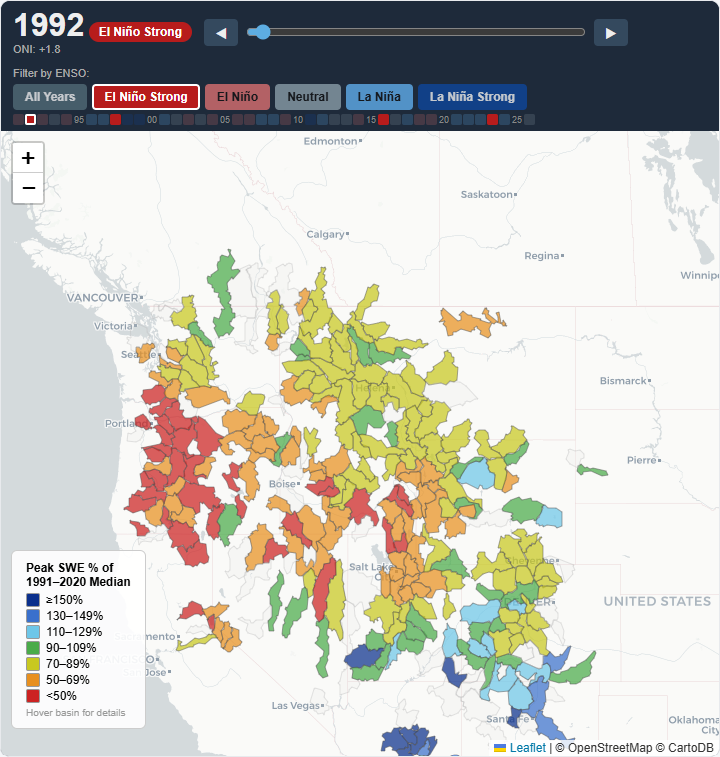
The ratio numbers above come alive when you can step through the actual years. Our Peak SWE History Map covers every HUC8 watershed in the West from 1982 to 2025 — filter to "El Niño Strong" and you can see exactly which basins light up blue and which turn red, year by year. The 1992 screenshot below (a strong El Niño at ONI +1.8) is a good example: the Pacific Northwest and Cascades run well below normal while the southern Rockies and Southwest hold up relatively well.